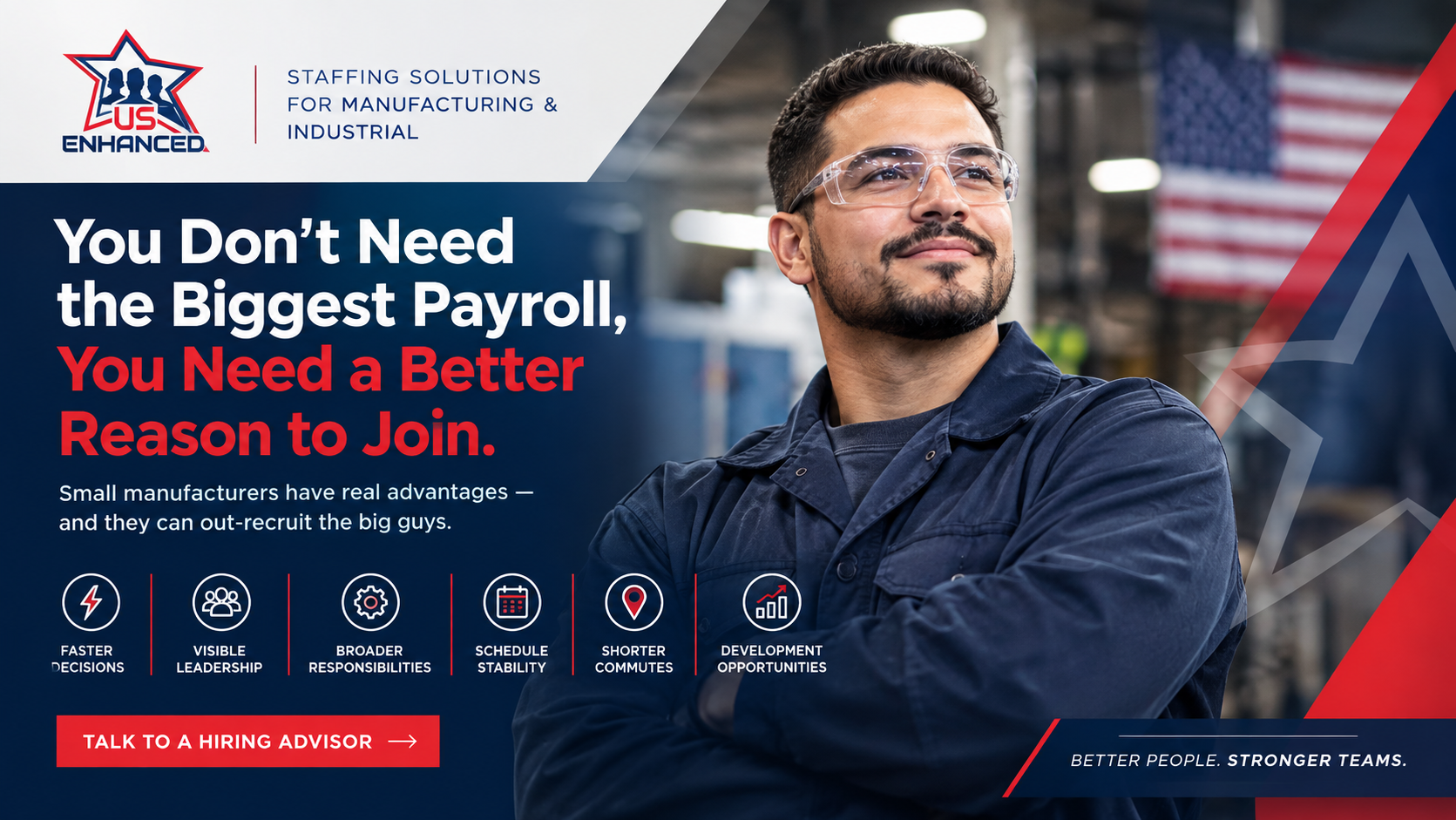
You do not need the biggest payroll, but you do need a credible reason to join.
If you're running a 50- to 200-person manufacturer in the Piedmont Triad, you already know a large plant down the road can post a higher starting wage than you can. That's real, and no amount of clever messaging changes it. But wage is one input into a candidate's decision, not the whole decision — and small manufacturers that understand what they can credibly offer often out-recruit companies with a bigger payroll and a weaker pitch.
Plenty of owners stop at the wage comparison and conclude they're at a permanent disadvantage. That's only true if pay is the only thing a candidate is weighing. In practice, skilled trades and production candidates are also weighing how fast they'll get an answer, who they'll actually work for, how varied the work is, whether the schedule will hold steady, how far they'll drive, whether there's a path forward, and whether anyone will know their name. A large plant doesn't automatically win on any of those — and a smaller company that leads with them has a real, honest story to tell.
Faster Decisions
A candidate who interviews at a 400-person plant may wait two weeks and three layers of approval for an offer. At a 75-person shop, the owner or plant manager can often make a call the same day. In a tight skilled trades market, speed alone wins candidates who have other offers on the table.
Visible Leadership
At a smaller operation, the plant manager knows every employee's name, and the owner isn't a rumor — they're on the floor. For candidates who've worked somewhere large and felt like a number, that visibility is a real, specific reason to make a move, not a soft selling point.
Broader Responsibilities
Big plants tend toward narrow, repetitive roles by design. Smaller shops more often need people who can run more than one machine, cover more than one process, and grow into more than one job. For candidates who want to build a wider skill set rather than repeat the same task for five years, that's a legitimate advantage — say it plainly.
Schedule Stability
Large plants running multiple shifts often carry more schedule volatility — mandatory overtime, rotating shifts, last-minute changes tied to a bigger, more complex production plan. A smaller operation with a steadier, more predictable schedule can make that a selling point directly, especially with candidates who have families or second jobs to plan around.
Shorter Commutes
Not every candidate wants to drive to an industrial park on the far side of Greensboro or Winston-Salem. A shop that's genuinely close to where people live in Kernersville, Lexington, Burlington, or Asheboro has a real, practical edge for local candidates who are done with a 45-minute commute each way.
Development Opportunities
In a smaller operation, a strong performer can move from operator to lead to supervisor faster than they would inside a large, multi-layered organization with a defined ladder and a long wait for the next rung. If that path is real at your company, describe it specifically — the vague promise of "room to grow" isn't credible on its own.
Smaller headcounts make it possible to actually know what's going on with your people — who's struggling, who's ready for more, who's about to leave. That's not a soft benefit. It's the reason problems get caught and addressed before they turn into resignations, which is a real advantage a large plant structurally can't replicate as easily.
None of this means pretending pay doesn't matter — it does, and a candidate who's genuinely underpaid for the market will leave regardless of how good the culture is. The goal isn't to talk around compensation. It's to be honest about where you stand on wage, and equally direct about the other, specific reasons a candidate would be better off with you than with a bigger plant down the road. A credible, specific pitch beats a vague one every time — and it beats "we're a family here" every time, too.
• Be upfront about where your pay sits in the local market — don't dodge the question
• Pick two or three advantages from this list that are genuinely true at your company, not all seven
• Make the advantage specific — a named path to supervisor, an actual commute time saved, a real schedule that hasn't changed in two years — not a generic claim
US Enhanced Personnel provides contract-to-hire and direct-hire staffing for manufacturing and industrial employers across the Piedmont Triad, including Greensboro, High Point, Winston-Salem, Burlington, Kernersville, Lexington, and Asheboro. We work as an advisor to employers, not simply a resume vendor — helping companies make hiring decisions they won't regret.
You may be interested in some of these articles.